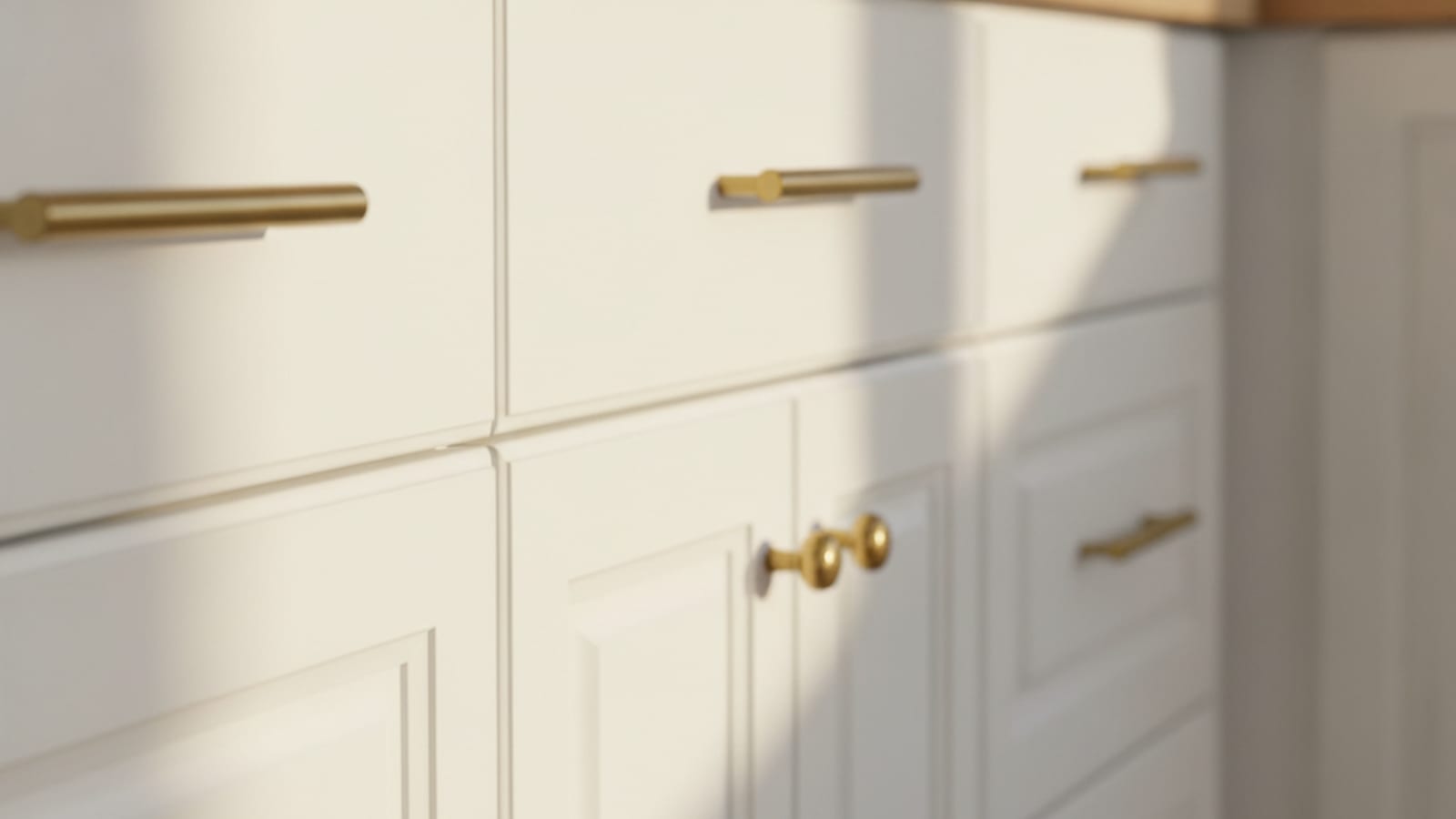
Hardware is the fastest, cheapest way to change how a kitchen feels without touching the cabinets themselves, and 2026 has a clear direction across Tampa Bay kitchens. If your cabinet boxes and doors are in good shape, a cabinet hardware upgrade alone can shift the whole look of the room in a single afternoon.
Brushed brass is still leading
Brushed and satin brass, warmer and less shiny than the polished brass of decades past, remains the most requested finish for pulls and knobs across the region. It pairs especially well with the warm white and greige cabinet colors that dominate local repaints right now, and it reads as current without feeling trendy in a way that’s likely to date quickly.
Matte black holds steady as the contrast choice
Matte black hardware continues to show up heavily in kitchens going for a higher-contrast, more modern look, especially paired with two-tone cabinets where a dark island meets lighter perimeter cabinetry. It’s a strong choice for newer construction across Wesley Chapel and Riverview, where more contemporary cabinet profiles are already common, though it also works well as a bold update on older cabinet boxes in Carrollwood and Town ‘n’ Country homes going through a repaint.
Integrated and edge pulls gaining ground
Integrated pulls, where the door or drawer front itself is milled with a finger groove instead of mounting separate hardware, are showing up more in higher-end and slab-front kitchens looking for a cleaner, hardware-free look. Edge pulls, a slim bar mounted along the top edge of a drawer front, offer a similar minimal look while still being a separate, replaceable piece of hardware, which makes them a more practical choice for homeowners who might want to change finishes again down the road.
Mixed metals, done carefully
Mixing two hardware finishes in one kitchen, brass pulls on upper cabinets with matte black on the island, for example, has moved from a bold statement to a fairly common and accepted approach. The key to making it work is intentional zoning rather than random mixing: one finish per distinct cabinet zone (perimeter vs. island, uppers vs. lowers) reads as designed, while scattering finishes randomly across a kitchen tends to look unplanned.
Pull size and proportion matter more than the trend itself
Oversized pulls on drawers, longer bar pulls that run most of the width of a wide drawer front, have picked up as a proportion-driven trend rather than a finish-driven one. On a standard-width drawer, a pull that’s too long for the space actually looks worse than a well-proportioned shorter pull in whatever finish you choose, so getting size right matters as much as picking the right color.
Doing a hardware-only upgrade the right way
A hardware-only swap works cleanly when new pulls or knobs can use the same mounting holes as the old hardware, or when you’re comfortable filling and touching up old holes for a different hole spacing. This is one of the fastest cabinet upgrades available, often completed in a single day for a full kitchen, and it’s a good starting point for homeowners easing into a bigger cabinet project down the road, whether that ends up being painting or full refacing later on.
Matching hole spacing before you fall in love with a style
Hole spacing, the distance between mounting screw holes on a pull, is the practical detail that determines whether a hardware swap is a same-day project or a small repair job. Standard spacings run in set increments, commonly 3 inches, 3.75 inches, 4 inches, 5 inches, and up for longer bar pulls, and matching your existing spacing lets new hardware go directly onto the old holes with no wood filler or touch-up needed. Falling in love with a pull style at a different spacing than what’s currently drilled means either filling and re-drilling every door and drawer front, which adds real labor cost across a full kitchen, or accepting a visible old hole next to the new hardware, which most homeowners want to avoid. Measuring your current spacing before shopping saves a lot of second-guessing during the hardware selection process.
Knobs vs. pulls: where each still makes sense
Pulls have dominated hardware trends for years, especially on drawers, but knobs haven’t disappeared entirely. Knobs remain a common and practical choice on upper cabinet doors and glass-front display cabinets, where a smaller hardware profile feels more proportional than a full-length bar pull. Some Tampa Bay kitchens mix the two deliberately, knobs on doors and pulls on drawers, which is a longstanding, classic combination that still reads as current rather than dated, especially in a warm brass or matte black finish that ties the two hardware types together visually.
Budgeting a hardware-only project
A full kitchen hardware swap for 25 to 35 pulls and knobs, mid-range quality hardware, typically runs $600 to $1,500 including hardware cost and installation labor, before factoring in any hole-filling or re-drilling for a different spacing. Premium or designer hardware lines can push the material cost alone well above that range, sometimes running $15 to $40 or more per piece for specialty finishes like unlacquered brass or hand-forged iron. Budget hardware in the $3 to $8 per piece range covers basic brushed nickel or matte black options that still look clean, just without the specialty finish detail of higher-end lines.
Where hardware trends are heading next
Warm, textured finishes, brushed and satin metals rather than high-polish or high-gloss options, show no sign of losing ground heading further into 2026, largely because they photograph and age better than high-shine finishes that show fingerprints and water spots constantly in daily kitchen use. Mixed-material pulls, combining a metal bar with a wood or leather-wrapped grip section, have started showing up in higher-end Tampa Bay kitchens as a more tactile alternative to all-metal hardware, though this remains a smaller niche trend rather than mainstream yet.
Matching hardware to faucets and appliances
Hardware doesn’t exist in isolation from the rest of a kitchen’s metal finishes. A brushed brass pull scheme reads best when it’s at least loosely coordinated with the kitchen faucet, cabinet-front appliance panels, and any exposed light fixture hardware in the same room, since three or four competing metal tones in one sightline tends to look unplanned rather than intentionally mixed. This doesn’t mean every metal finish in the kitchen needs to match exactly. A common and effective approach pairs a stainless or matte black appliance suite with warm brass cabinet hardware and a matching matte black or brass faucet, giving the room one clear accent metal rather than several competing ones.
Shopping hardware in person before ordering
Photos and online listings rarely capture how a finish actually reads in real kitchen lighting, particularly with brass tones that can look noticeably more yellow or more muted depending on the light source. Seeing and handling a physical sample under your kitchen’s actual lighting, whether that’s under-cabinet LED strips, recessed can lights, or natural window light, before ordering a full kitchen’s worth of hardware avoids a common and expensive mistake: ordering 30 pulls in a finish that looked right on a screen but reads differently once installed under your specific lighting conditions.
What’s the most popular cabinet hardware finish in Tampa Bay right now?
Brushed and satin brass remains the most requested finish, especially paired with warm white and greige cabinet colors that are common across current repaints in the region.
Is matte black hardware still trending for 2026?
Yes, particularly in two-tone kitchens and newer construction with more contemporary cabinet profiles, though it also works as a bold update on older cabinet boxes going through a repaint.
Can I mix two hardware finishes in one kitchen?
Yes, and it’s become a common approach. It works best with intentional zoning, like one finish on perimeter cabinets and another on the island, rather than mixing finishes randomly throughout the kitchen.
How long does a hardware-only cabinet upgrade take?
Often a single day for a full kitchen, especially if the new hardware can use the existing mounting holes. It’s one of the fastest and most affordable cabinet upgrades available.
A trend is worth chasing when it also fits how you actually use your kitchen day to day, not just how it photographs. A busy household with kids grabbing drawers constantly may get more real value out of a durable, easy-grip pull than a minimal integrated groove that looks sleek but is harder to use one-handed while carrying a plate.
Ready to update your hardware or plan a bigger cabinet refresh? Call (813) 000-0000 and we’ll connect you with an insured local crew for a free quote anywhere across Tampa Bay.