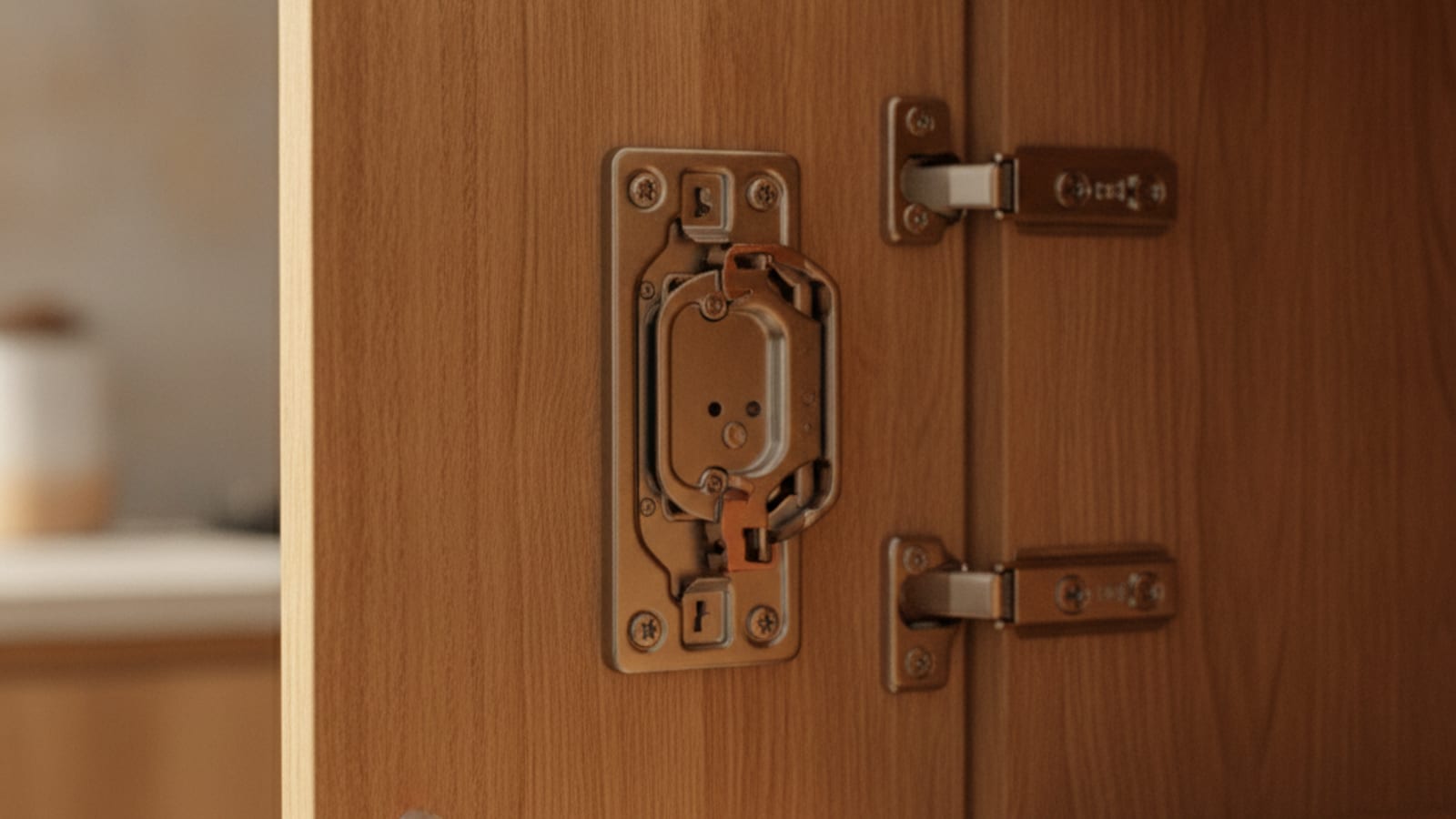
Soft-close hardware gets asked about constantly during cabinet consults across Tampa Bay, and the humidity question is a fair one. Florida’s air is thick for most of the year, and hardware that relies on a hydraulic or pneumatic damper mechanism has moving parts that could, in theory, react to that moisture. Here’s what actually happens.
How soft-close mechanisms work
Soft-close hinges and drawer slides use a small hydraulic or air-piston damper that slows the last few inches of travel so a door or drawer eases shut instead of slamming. It’s a sealed mechanical unit, not an open spring or exposed lubricant, which matters a lot for how it holds up in humid conditions.
What humidity actually affects
Humidity’s real impact on cabinets shows up in the wood and wood composite parts, not the hardware. MDF and particleboard panels absorb moisture from the air and can swell slightly, which changes how a door or drawer fits in its opening over a humid Florida summer versus a drier winter month. That swelling is what causes a door to feel slightly tight or a drawer to stick, not the hinge mechanism itself.
The sealed damper units in quality soft-close hardware are largely unaffected by ambient humidity. Where hardware quality does matter is corrosion resistance on any exposed metal, particularly in kitchens near open windows or in homes close to the coast where salt air adds an extra corrosion factor on top of humidity.
When soft-close hardware actually fails
Failure usually traces back to one of three things: cheap hardware with a thin or poorly sealed damper housing, a door or drawer that’s slightly out of alignment putting uneven stress on the hinge, or age, since even good soft-close mechanisms have a service life and eventually the damper loses its resistance and the door starts closing faster again. None of those three are humidity-specific problems, they’re quality, installation, and wear issues that would show up in any climate.
Retrofitting existing cabinets vs. building it in from the start
Soft-close conversion on existing hinges and drawer slides is a straightforward, door-by-door and drawer-by-drawer swap in most cases, and it’s one of the better value upgrades available for cabinets that are otherwise in good shape. Standard European-style hinges can usually be swapped for a soft-close version without replacing the whole hinge plate, which keeps the cost per door reasonable.
Building soft-close hardware in from the start, whether during a custom cabinet build or new cabinet installation, costs less per door than retrofitting later, since the labor is folded into the original install rather than being a separate visit. If you’re already replacing cabinets, specifying soft-close from the beginning is the better value. If your existing cabinets are sound and you just want the upgrade, retrofitting is a reasonable standalone project.
Is it worth it specifically in a Florida kitchen
Yes, for reasons that have less to do with humidity and more to do with daily use. Florida kitchens tend to see heavy daily traffic given the amount of time spent indoors during summer heat, and soft-close hardware reduces wear on cabinet boxes and face frames over years of hard door and drawer slams. The humidity concern that stops some homeowners from upgrading turns out to be mostly a non-issue with quality hardware and proper alignment.
What to look for in quality soft-close hardware
Not all soft-close hardware is built the same, and the price difference between budget and quality hinges usually reflects real durability differences rather than brand markup alone. Look for hinges and slides with a fully enclosed damper housing rather than an exposed piston, since enclosed units resist dust and airborne moisture better over years of use. Metal-bodied hinges generally outlast heavily plastic-bodied versions, particularly on cabinets that see frequent daily use like a main pantry door or the cabinet under a busy sink.
Reputable hardware manufacturers typically rate their soft-close mechanisms for a specific number of open-close cycles, often 50,000 to 80,000 or more for quality units. Cheaper unrated hardware may look identical on the shelf but often fails well before that threshold, which is why sourcing hardware through an installer who stands behind the brand matters more than shopping for the lowest price per hinge.
Alignment: the step that determines whether soft-close hardware lasts
Even quality soft-close hardware fails early if the door or drawer isn’t properly aligned during installation. A door that’s slightly out of square puts uneven pressure on the damper every time it closes, which wears the mechanism faster than normal use would. This is one of the most common issues with a rushed retrofit job, since taking the time to fine-tune each hinge’s adjustment screws after installation is a step that’s easy to skip but expensive to ignore. A crew that checks and adjusts every door after installing soft-close hardware, rather than moving straight to the next cabinet, is doing the job correctly.
Coastal Tampa Bay homes and salt air exposure
Homes closer to the water, in areas like St. Pete Beach, Clearwater Beach, or the barrier islands, deal with salt air on top of standard humidity, which is a real factor for any exposed metal hardware, soft-close or otherwise. Stainless steel or specially coated hardware resists this corrosion better than standard zinc-plated hinges, and it’s worth specifically asking about corrosion-resistant hardware options if your kitchen is within a few miles of the coast, even if the kitchen itself is fully indoors and air-conditioned.
Drawer slides vs. hinges: is it worth upgrading both
Homeowners sometimes assume soft-close hinges and soft-close drawer slides are the same upgrade, but they’re separate hardware systems with separate costs. Hinges control door swing and closing, while slides control drawer extension and closing, and a kitchen can have one upgraded without the other. In practice, drawers tend to see more forceful daily slamming than doors, especially in households with kids, so if budget only allows for one upgrade at a time, soft-close drawer slides on the most-used drawers, silverware, junk drawer, pot and pan storage, often deliver more day-to-day benefit than starting with door hinges alone. A full retrofit eventually covers both, but there’s no rule requiring it to happen in a single visit if budget or scheduling favors doing it in phases.
What a soft-close consult should cover before you commit
A crew quoting a soft-close retrofit should count doors and drawers separately, since pricing is almost always per unit rather than a flat kitchen rate, and should check hinge and slide compatibility with your specific cabinet brand and age, since some older or imported cabinet lines use non-standard hinge cups that don’t accept a universal soft-close replacement without an adapter plate. Asking whether the quote includes adjustment and testing of every door and drawer after installation, not just the parts and labor to physically swap the hardware, is worth confirming upfront, since that final adjustment step is what actually determines whether the upgrade feels smooth on day one or needs a callback visit to fix uneven closing.
Does Florida’s humidity damage soft-close cabinet hinges?
Not typically. The sealed damper mechanism in quality soft-close hardware is largely unaffected by ambient humidity. Humidity’s real effect shows up in wood and composite panel swelling, not the hinge itself.
Is it worth retrofitting soft-close hinges onto existing cabinets?
Usually, yes, if the cabinets are otherwise in good shape. It’s one of the better value upgrades for existing boxes and can typically be done door by door without replacing the whole hinge plate.
Why do soft-close hinges sometimes stop working properly?
The most common causes are cheap hardware with a poorly sealed damper housing, doors that are slightly out of alignment, or normal age-related wear on the damper mechanism, not humidity itself.
Is it cheaper to add soft-close hardware during a new install or retrofit it later?
Building it in during a new cabinet install or custom build costs less per door since the labor is part of the original project. Retrofitting later is still reasonable but runs slightly higher per door.
Counting your own doors and drawers before your consult, and noting which ones bother you most with hard slamming, helps a crew put together a faster, more accurate quote on the first visit.
Curious what soft-close conversion would cost for your kitchen? Call (813) 000-0000 and we’ll connect you with an insured local crew for a free quote anywhere across Tampa Bay.