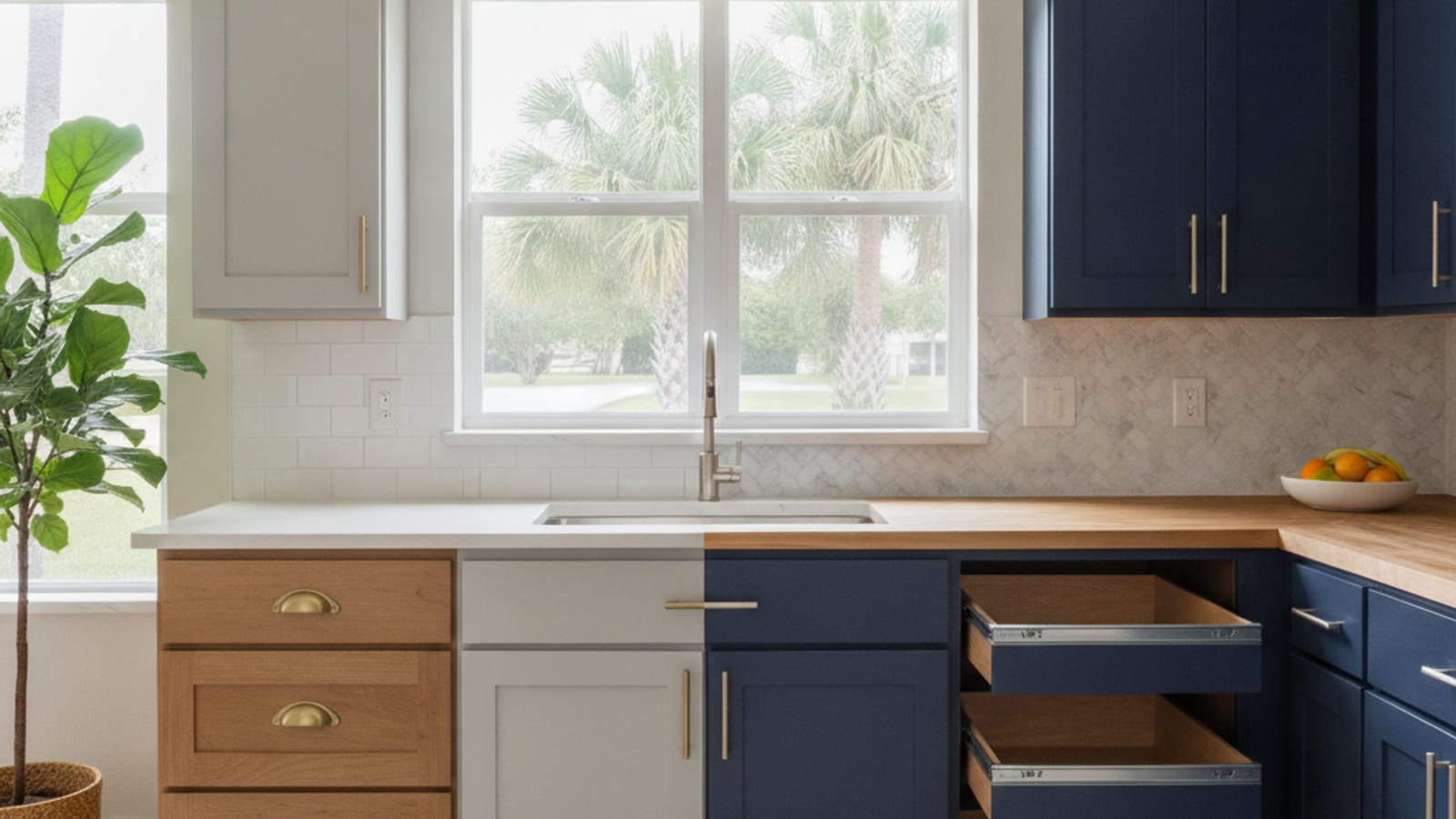
Homeowners land in one of two camps once they start pricing out a cabinet project: refacing feels like the obvious budget move, but it isn’t always the right call. The decision comes down to four things: box condition, whether the layout is changing, budget, and how much time you can live without a working kitchen. Here’s how to work through it.
Start with box condition, not price
Before anything else, open the doors and look at the inside of every cabinet, especially under the sink and around the dishwasher. Swollen particleboard, soft spots, or visible mold at the base of a cabinet box means that box needs to be repaired or replaced, full stop. Cabinet refacing covers the visible surfaces, not the structure underneath, so refacing over compromised boxes just delays a bigger repair.
If most of your boxes are dry, square, and free of water damage, you’re a candidate for refacing. If more than a few boxes have structural issues, price out repair-plus-refacing against straight replacement before deciding, since the math often flips in replacement’s favor once repair labor gets added in.
Is the layout changing at all
This is the fastest way to rule refacing out. Moving a sink, widening a doorway into the kitchen, adding an island, or changing where the refrigerator sits all require new boxes built to the new dimensions. Refacing only makes sense when you’re keeping the cabinet footprint exactly as it is. If you want a different layout, new cabinet installation is the only path, since there’s no box to reface into a new configuration.
Budget: what each option actually costs
Refacing a mid-size kitchen typically runs $7,500 to $12,000. Full replacement with new boxes, for the same size kitchen, generally runs $18,000 to $35,000 depending on box material, door style, and whether you’re doing stock, semi-custom, or fully custom cabinets. That gap is real money, and it’s the main reason refacing stays popular even among homeowners who could afford replacement.
The gap narrows fast, though, once a refacing project uncovers structural repairs. A kitchen quoted at $8,000 for refacing can climb close to replacement pricing once several boxes need to be rebuilt from the inside out.
Timeline differences
Refacing a typical kitchen takes about one to two weeks from template to finished install, and you can usually keep using part of the kitchen during the process since the boxes stay in place. Full replacement takes longer, generally three to six weeks depending on whether cabinets are stock, semi-custom, or built to order, and the kitchen is largely unusable during demo and installation.
If you’re working around a tight timeline, like getting a home ready to list or hosting a specific event, that difference matters as much as the price gap.
A simple way to decide
Ask yourself three questions. Are the boxes structurally sound? Is the layout staying the same? Can the budget handle full replacement if it turns out the boxes aren’t sound? If you answer yes to the first two, refacing is almost always the right move. If you answer no to either one, replacement is usually the more honest answer, even if it costs more up front.
Older Tampa Bay homes built before 1970 tend to have sturdier original cabinet boxes than homes built during the fast-growth decades of the 1970s through 1990s, when cheaper particleboard construction was more common. That’s a generalization, not a guarantee, which is why an in-person box inspection matters more than the build year alone.
What resale value has to do with the decision
If you’re weighing this project ahead of a future sale rather than for your own long-term use, the calculation shifts slightly. Refacing improves the look of a kitchen for a buyer walkthrough at a fraction of replacement cost, and in a lot of Tampa Bay markets a clean, updated-looking kitchen matters more to a buyer’s first impression than whether the cabinet boxes are technically new. Full replacement makes more sense ahead of a sale mainly when the current layout itself is a liability, like a closed-off galley kitchen buyers keep passing on, rather than when the cabinets simply look dated.
Mixing the two approaches in one kitchen
Refacing and replacement aren’t always all-or-nothing. Some Tampa Bay kitchens end up as a hybrid: refacing the majority of sound boxes while replacing a handful of damaged ones, like the sink base cabinet that took on water years ago while the rest of the kitchen stayed dry. This approach requires a crew that can match new box construction to refaced surfaces closely enough that the seam isn’t obvious, which isn’t every shop’s specialty, so it’s worth asking directly whether a contractor has done hybrid projects before assuming it’s an option.
Questions worth asking during your consult
Beyond box condition, ask what the crew’s process is for finding hidden damage before the project starts rather than after doors are removed. Ask whether the quote includes a walkthrough of every cabinet interior, not just a visual assessment of the door fronts. And ask how change orders get handled if a box turns out to need repair mid-project, since a clear answer here up front avoids a lot of frustration if the scope shifts once work begins.
What most Tampa Bay homeowners end up choosing
In practice, refacing wins out in the majority of Tampa Bay projects simply because most kitchens don’t need a layout change and most boxes, even older ones, turn out to be structurally sound once inspected. Replacement tends to cluster around two situations: homes with a documented history of plumbing leaks near the cabinets, and homeowners who are already planning a broader layout change for other reasons, like moving an appliance or opening up a wall, where new cabinets get built into that larger plan anyway.
A note on permits
Refacing typically doesn’t trigger a permit in most Tampa Bay jurisdictions, since it doesn’t involve structural, plumbing, or electrical changes and the cabinet boxes stay exactly where they are. Full replacement can trigger a permit requirement if the project involves moving plumbing or electrical, like relocating a sink or adding under-cabinet lighting circuits, even though the cabinets themselves generally don’t require a permit on their own. Requirements vary by county and municipality across Hillsborough, Pinellas, and Pasco, so it’s worth asking your contractor directly whether your specific project scope triggers a permit rather than assuming either way, and verifying with your local building department if there’s any doubt.
How long each option keeps you satisfied
Refacing and replacement both reset the visual age of a kitchen, but they age differently over the following decade. Refaced cabinets, since they carry new doors and veneer over an older box, tend to show their age again sooner if the underlying box was already decades old when the refacing happened, simply because the box’s structural life clock didn’t reset along with the surfaces. Full replacement resets both the surface look and the underlying structure at the same time, which is part of why it costs more but also why it tends to hold up longer before the next update is needed. Neither answer is wrong, it’s a question of whether you’re solving for the next 5 to 10 years or planning to stay in the home for two or three decades.
Is cabinet refacing cheaper than replacement in every case?
Almost always upfront, but not always once structural repairs are factored in. A kitchen with several water-damaged boxes can end up costing close to replacement pricing once repair labor is added to the refacing quote.
Can I reface cabinets if I want to change my kitchen layout?
No. Refacing covers the existing boxes in their current position. Any layout change, including moving a sink or adding an island, requires new cabinet boxes built for the new configuration.
How do I know if my cabinet boxes are sound enough to reface?
Check the interior of every box, especially under the sink and dishwasher, for swelling, soft spots, or mold. A crew doing an in-home consult should physically inspect box condition before quoting refacing rather than replacement.
How much faster is refacing compared to full replacement?
Refacing typically takes one to two weeks. Full replacement generally takes three to six weeks depending on whether the new cabinets are stock, semi-custom, or custom-built.
Not sure which side of this decision your kitchen falls on? Call (813) 000-0000 and we’ll connect you with an insured local crew for a free in-home consult and an honest read on your boxes before you commit either way.